Our air is exposed to a wide range of pollutants – fine dust, CO₂, NOx, and TVOCs can pose long-term health risks. Pollutants enter not only from outside but also arise from industrial processes or everyday office activities.
Why is clean air important?
Gases such as CO₂, CO, TVOCs, and NOx enter the body directly through respiration and affect us in various ways – often unnoticed, but with long-term impact. They can cause respiratory irritation, headaches, or fatigue, reduce concentration, and negatively affect overall well-being. Prolonged exposure may lead to serious health consequences, including cardiovascular or organ damage.
Neglecting air quality does not just risk short-term discomfort; it can lead to potentially permanent impairments – often without immediate symptoms.
The ASR A3.6 standard requires:
- Air that is beneficial to health, typically at levels comparable to outdoor air.
- CO₂ measurements under real usage conditions to detect critical values early.
Measured values are compared with limit and guideline values to assess indoor air quality. If limits are exceeded, immediate measures must be taken to improve air quality or protect employees – even when outdoor air is polluted.
Where does fine dust come from?
Fine dust is not only generated by industrial production or traffic – polluted outdoor air can enter indoor spaces through open or leaky windows. Numerous internal sources also contribute: shredders, vacuum cleaners, open fireplaces, poorly maintained air conditioning systems, or ventilation units. Even building works inside the premises release fine dust. All of this significantly increases exposure, can irritate the respiratory system, and affect health over time.
BAPPUnow turns measurement data into smart decisions:
With VOCOOnx’s app and cloud connectivity, all measurement data is available at any time. This allows building managers to make informed decisions, optimise spaces, and sustainably improve air quality. Pollutants become visible, comfort increases, and occupational safety becomes measurable.
Ready to use and fully mobile:
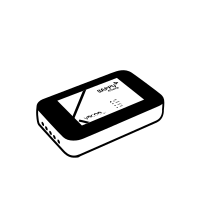
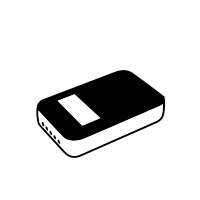
Switch on, carry, measure. The LED traffic-light system and display provide clear air quality readings. VOCOOnx is battery-powered, compact, and wireless – ideal for offices, industrial sites, construction sites, and transport.
VOCOOnx - plug, play, spot everything.
We are currently finalizing the last details before shipment. Due to high demand and final optimizations, shipping is expected to begin this summer.
Request a quote for VOCOOnx here: contact or email This email address is being protected from spambots. You need JavaScript enabled to view it.
In modern working and living spaces, people spend most of their day indoors. This makes indoor air quality all the more important, as it affects well-being, concentration and performance. Optimal air quality depends not only on CO2, but also on particulate matter and other factors such as unpleasant odours or substances that are relevant to health.
Carbon dioxide (CO₂)
CO₂ is considered a key indicator for indoor ventilation. Only at concentrations significantly above the level of outdoor air can attention and performance be impaired, as described in the Technical Rules for Workplaces (ASR 3.6). At the same time, as CO₂ levels rise, so do organic emissions and odours emitted by humans themselves. The measurement of CO2 therefore remains an essential part of objective air quality assessment.
Total Volatile Organic Compounds (TVOC)
TVOCs are gaseous organic substances that originate from solvents, synthetic materials or biological processes. TVOCs can pollute indoor air, especially after construction or renovation work. They are not always harmful to health, but can cause odours, irritation and discomfort. According to ASR 3.6, such substance loads should be minimised.
Carbon monoxide (CO)
CO is produced when carbon-containing materials are incompletely combusted. Indoors, leaky chimneys, gas stoves, wood pellets, petrol-powered appliances or smoking can significantly increase CO concentrations. Even small amounts of CO can impair well-being and performance.
Particulate matter (PM1, PM2.5, PM4, PM10)
Particulate matter is a critical parameter of indoor air quality. It can originate from outdoor air (e.g. traffic, industry) or internal sources such as dust swirls, construction work, wood or pellet stoves, smoking or certain production processes. The particle sizes have different health effects:
PM10: Coarse particles that mainly irritate the respiratory tract.
PM4: Medium-sized particles that penetrate deeper into the bronchi.
PM2.5: Fine dust that enters the alveoli and can put long-term strain on the cardiovascular system.
PM1: Ultrafine particles, some of which can enter the bloodstream directly and cause systemic effects.
These measurements are particularly relevant for occupational safety. Professional associations and TRGS guidelines set limit values for different activities and room uses. Continuous monitoring of fine dust enables occupational safety specialists to identify hazards, optimise ventilation concepts and ensure the health protection of employees.
 BAPPUevo
 IRevo
IRevo ANEMOMETERevo
  VOCOOsx-evo
 VOCOOnx
 GLOBEevo
 Transport
 Accessories
 Technical Data
 BAPPUnow
 BAPPU-time
 BAPPU Windows-Software
 VOCOO+
 Downloads
 Contact